Guides for Use & Maintenance
How to Wash Period Panties So They Last for Years
“I washed them like any other underwear and within a few months they didn’t absorb the same”: it’s the number-one reason people are disappointed with


“Is it better to wash with regular soap or just water during my period?” It’s one of those questions many women ask themselves in silence, without quite knowing who to ask. The good news is that intimate hygiene during your period isn’t complicated: it’s 3-4 simple habits done well, far more than special products or elaborate rituals. Here’s the complete routine, explained without jargon and based on what medical evidence supports, not what advertising sells best.
The vagina keeps a naturally acidic pH, between 3.8 and 4.5, thanks to the lactobacilli that make up your protective vaginal flora. During your period, blood —which has a more neutral pH— temporarily upsets that balance, making the area a little more prone to irritation and to the growth of opportunistic microorganisms. It doesn’t mean you’re “dirtier” or that you need harsh products: it means it’s worth taking a little more care of the basics on those days.
This nuance matters because the intimate hygiene market usually sells exactly the opposite: gels with strong fragrances, “purifying” wipes or vaginal douches that promise freshness, when in reality what the vagina needs during your period is less intervention, not more. Understanding this saves you spending on unnecessary products and, above all, avoids irritation that’s harder to fix than to prevent.
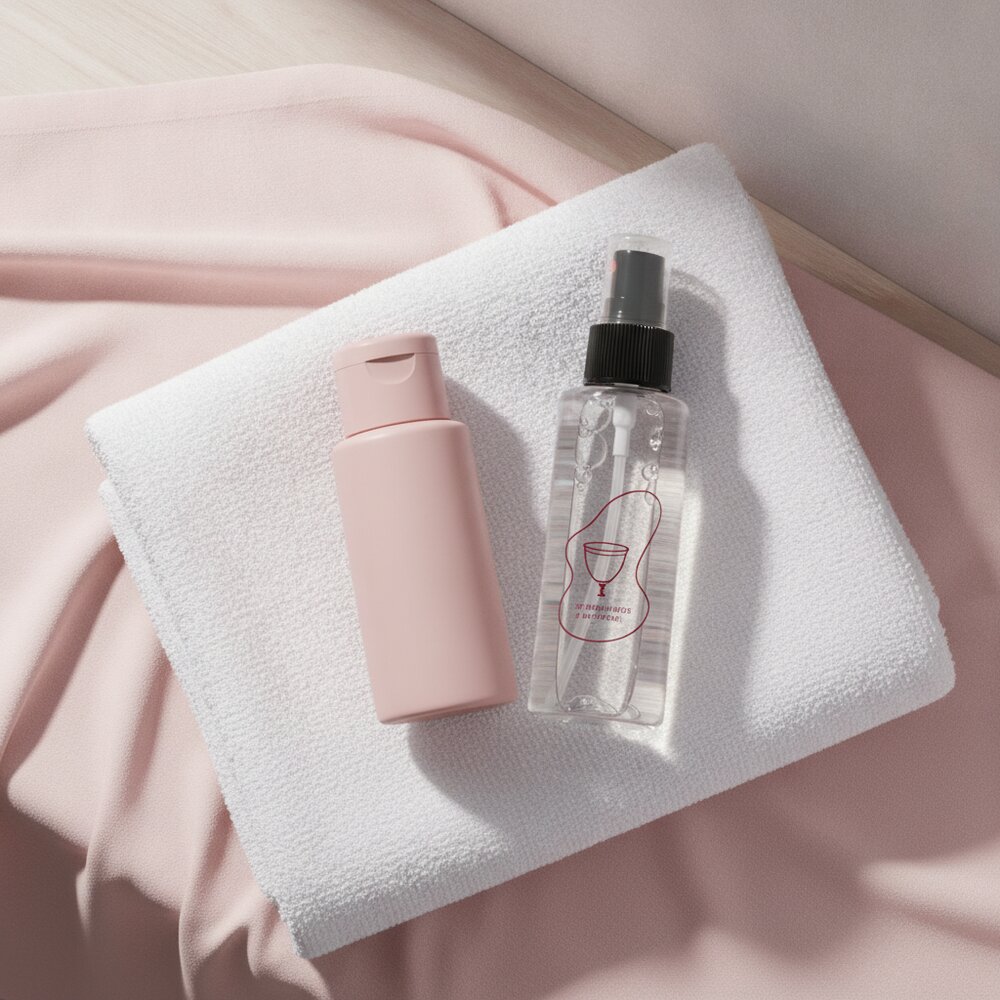
Chilly intimate gel with probiotic complex, pH 3.5 (€3.99) is formulated precisely to respect that balance, unlike ordinary soap. It’s the kind of small habit that makes the difference between a comfortable period and one with avoidable discomfort. Shipped from Spain in 24-72h.
There are very widespread habits that, however well-intentioned, can do more harm than good:
If you notice persistent itching, foul-smelling discharge or discomfort that doesn’t improve with this basic care, it may be an infection that needs specific treatment: we go over the most common ones in our guide to vaginal thrush and other infections: how to treat them, and if what concerns you is the particular smell of your discharge, see foul-smelling vaginal discharge: causes and treatment.
The basic routine is the same for everyone, but there are nuances depending on what you use:
To take cleaning with you when you’re out, the Sileu Cleaner Spray (€5.99) cleans the menstrual cup with no need to rinse with water, ideal for work, travel or any restroom without a sink in the stall. Shipped from Spain in 24-72h.
Water alone is enough for most women most of the time, and it’s in fact the safest default recommendation. An intimate hygiene gel formulated with an acidic pH (not ordinary soap) can help on days of more sweating, physical activity or simply if you prefer that clean feeling, as long as it’s used in moderation —there’s no need to wash several times a day or scrub too hard, which also irritates. Neither water nor a good pH-balanced gel cures an active infection: if you already have symptoms, you need specific treatment, not just a change of hygiene routine.
There’s also no need to change gel depending on the phase of your cycle: a general-use acidic-pH gel works just as well during your period as the rest of the month. What does change is how often you change your protection and how much attention you pay to moisture, which is why many women keep a specific gel mainly for these days and use only water the rest of the cycle — though that isn’t a strict rule or the only correct way to do it.
If you’ve just had your first period, or you’re the mom of a teenager who’s starting, the routine is no different from what’s explained above: water or an acidic-pH gel, frequent changes and breathable clothing. The only thing that usually takes more practice is getting into the rhythm of when to change protection, because at first it’s easy to lose track. If you exercise during your period, bear in mind that sweat adds extra moisture to the area, so on those days it may pay to change your protection a little earlier than usual and, if possible, shower afterwards with the basic routine rather than staying in your sportswear longer than necessary. Many athletes who use a menstrual cup value precisely that it copes well with movement without needing as many changes as a pad.
Away from home —at work, traveling or on a long day— you don’t always have access to a shower, and that’s fine: unscented intimate wipes for a quick freshen-up, changing your protection when you can and washing your hands before and after are enough to keep up your hygiene without needing perfect conditions.
The recommendation to avoid vaginal douches and prioritize acidic-pH products isn’t a fad: it’s backed by reference medical sources. According to MedlinePlus, vaginal douches can worsen vaginitis symptoms by removing the healthy bacteria that line the vagina, so they aren’t recommended as a routine hygiene practice (source: MedlinePlus, vaginitis self-care). Keeping the routine simple —water, a pH-balanced gel if you prefer, frequent changes of protection and breathable clothing— remains by far the best-supported option.
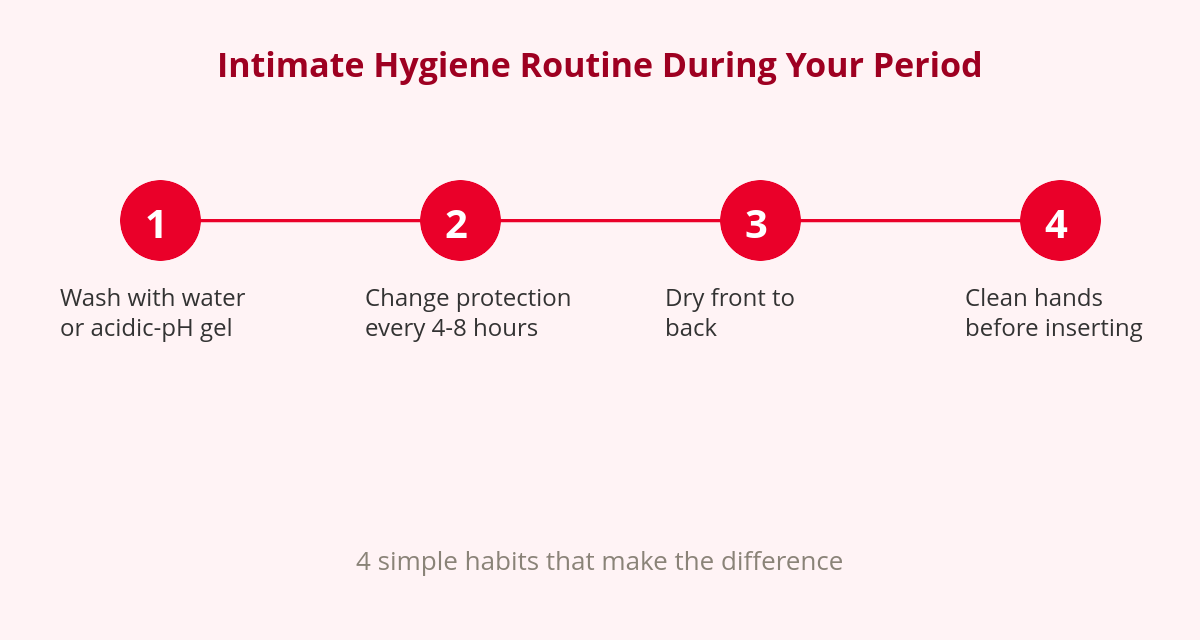
Wash the area with water or an acidic-pH gel (never ordinary soap), change your protection every 4-8 hours, wipe from front to back and wash your hands before touching your intimate area. No complicated ritual is needed.
No. Vaginal douches remove the protective bacterial flora and upset the natural pH, which can worsen vaginitis symptoms instead of improving them. Intimate hygiene with water or an acidic-pH gel is enough.
One formulated with an acidic pH (between 3.5 and 5), without harsh fragrances, instead of a conventional shower gel, which is usually too alkaline for the intimate area and can encourage irritation.
Pads and tampons every 4-8 hours depending on your flow and the pack instructions; a menstrual cup can last longer, up to 12 hours if your period isn’t very heavy, but it should be emptied and cleaned regularly.
Yes. Tight clothing and synthetic fabrics trap moisture and heat, an environment that encourages the growth of yeast and bacteria. Breathable cotton reduces that risk, especially during your period.
Keep reading:
“I washed them like any other underwear and within a few months they didn’t absorb the same”: it’s the number-one reason people are disappointed with
“I’ve had the same cup for three years, should I replace it now?” It’s a question we get often, and the honest answer is: it
We sell menstrual cups, so you’d expect this article to tell you the cup is perfect for everyone. It isn’t, and we’d rather tell you

