Guides for Use & Maintenance
How to Wash Period Panties So They Last for Years
“I washed them like any other underwear and within a few months they didn’t absorb the same”: it’s the number-one reason people are disappointed with

Did you know that someone using tampons spends an average of €60-120 a year, and over a fertile lifetime that figure can add up to over €2,000? It’s the number nobody mentions in the supermarket aisle. Comparing menstrual cup vs. tampons isn’t just a matter of preference: there’s real cost, there’s scientific evidence on safety, and there’s a comfort difference you can only really understand by trying it. Here are the facts, without overstating anything in either direction.
| Sileu Menstrual Cup | Tampons | |
|---|---|---|
| Capacity | 25-30 ml (Classic/Soft) | 5-10 ml, needs changing several times a day |
| Safe wear time | up to 12h | maximum 8h (per manufacturers) |
| Upfront cost | €14.99 (lasts years) | €3-6 per box (lasts days) |
| Material | Medical-grade silicone, certified ISO 10993 | Cotton and/or rayon, varies by brand |
| Waste | Practically zero after purchase | A new one every change, plus wrapper |
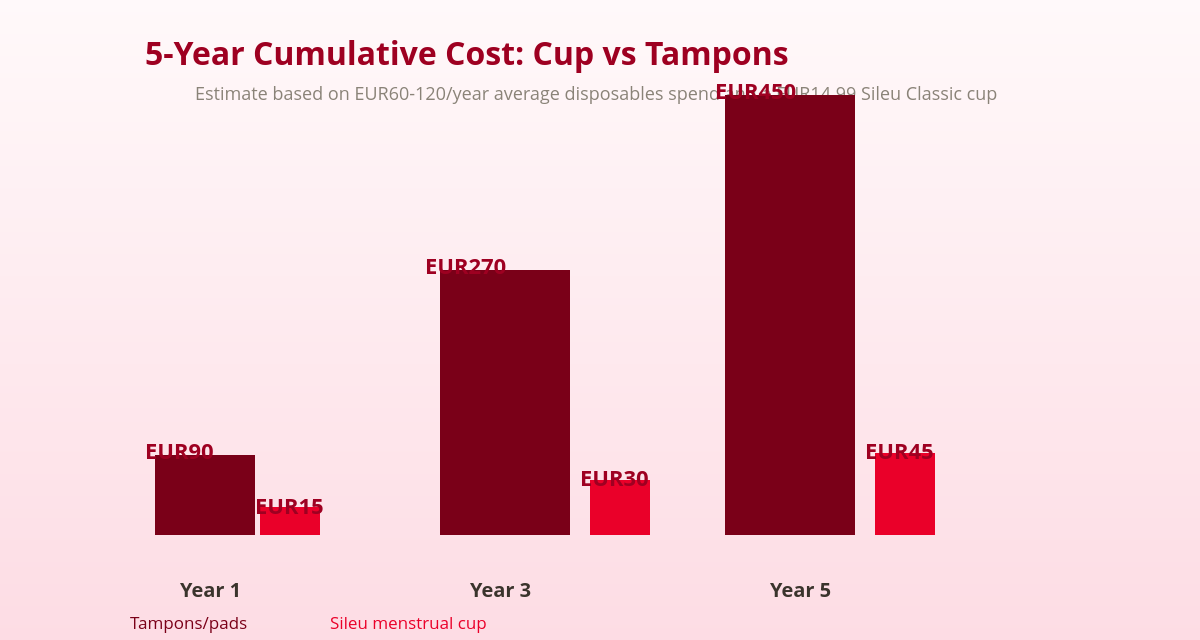
With an average spend of €60-120 a year on tampons (a typical figure in menstrual spending studies), over 5 years that’s €300 to €600. With a Sileu menstrual cup, the spend is the cup itself (€14.99-19.99) and, at most, a second replacement cup after two or three years: under €45 over the same period.
Here’s the angle almost nobody mentions: the disposables industry runs on the monthly repurchase. A €15-20 cup that lasts for years simply has nobody advertising it on TV. People who switch to a cup usually end up wondering why they didn’t do it sooner.
Start the switch: Sileu Classic — €14.99
Our most versatile model, for light to heavy flow. Certified medical-grade silicone, ISO 10993 (surgical-medical grade). Shipped from Spain in 24-72h.
No need to speculate: the systematic review and meta-analysis in The Lancet Public Health (2019), covering 43 studies and over 3,300 participants, concludes that the menstrual cup is a safe option, with no adverse effects on vaginal flora, and leakage rates equal to or lower than tampons and pads. To date, it’s the most comprehensive review directly comparing both products.
On toxic shock syndrome (TSS), the most serious and least frequent complication linked to internal menstrual products, it’s worth being precise: the first documented cases in the 1980s were tied to very high-absorbency tampons, and regulations have since changed. With the cup, the Lancet review also found a handful of isolated cases among thousands of users. For both products, the risk drops when you follow recommended wear times and proper hygiene when inserting and removing. You can read more in MedlinePlus’s page on toxic shock syndrome.
If you want to dig into the specific materials of each cup, our roundup of scientific evidence on the menstrual cup gathers the available studies, and in quality certifications of best-selling cups we explain how to tell a certified cup from one that isn’t.
With a tampon, how often you change depends on your flow: it can be every 2-4 hours on heavy days. With the cup, that interval stretches out because capacity is two or three times higher, which especially shows in two situations: doing sport without thinking about changing mid-session (we cover this in menstrual cup for athletes) and sleeping without waking up in the middle of the night, which we go into in our guide to sleeping with a menstrual cup all night.
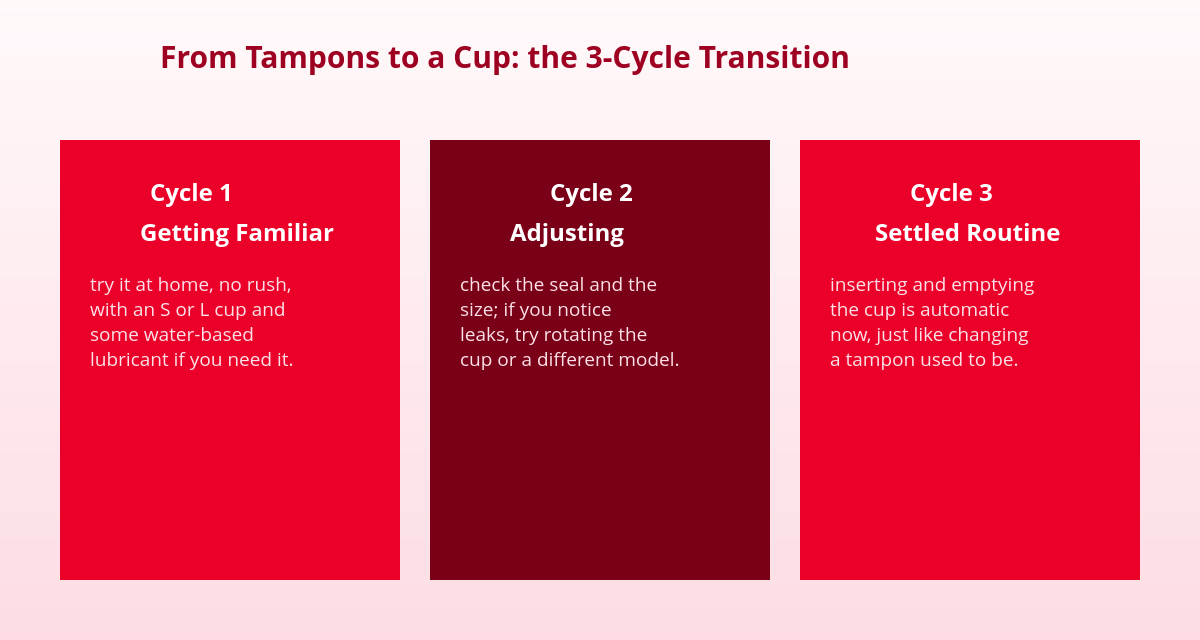
The learning curve is the one place a tampon wins in the short term: the first time you insert a cup, you’ll notice it takes more practice, especially finding the fold that best suits your body and recognizing the feeling of a full seal. It’s normal for the first two or three times to take a bit longer than you’re used to with a tampon; it’s not a failure on your part or the cup’s, it’s simply a different learning curve. That’s why we recommend a gradual transition instead of an abrupt switch:
If you have a low cervix or find the cup uncomfortable at first, the Sileu Soft is designed exactly for sensitive bladders and bodies that need softer silicone: it’s our usual recommendation for anyone coming straight from years of tampon use. Read more in our comparison of all seven Sileu models.
For sensitive skin and bodies: Sileu Soft — €14.99
Softer silicone, designed for a sensitive bladder and for anyone coming from years of tampon use. Same ISO 10993 certification as the rest of the range. Shipped from Spain in 24-72h.
A conservative estimate puts the number of tampons and applicators a person uses over their fertile lifetime in the thousands, almost all with plastic in the wrapper or applicator. A menstrual cup cuts that waste down to practically zero after the initial purchase. If you want to dig into the environmental impact further, in the carbon footprint of pads and tampons we break it down with figures.
Not everyone gets on with the cup right away, and that’s fine. If you want to cut down on disposables without going all in, OEKO-TEX Standard 100 certified organic cotton period underwear (free from harmful substances) is a reusable, insertion-free alternative, and many people combine it with the cup as backup on heavier flow days. If you’re coming straight from tampons and want to make the switch with a safety net, our guide to transitioning to a menstrual cup walks you through it step by step.
There are also specific situations where it’s worth taking it slow or checking with your gynecologist first: if you have an IUD, if you’re in immediate postpartum, or if you have any pelvic floor condition. These aren’t automatic reasons to rule out the cup, but they are good reasons to settle any doubt with a professional before deciding — something we apply with the same cautious standard across our whole site: you won’t find miracle promises here, just verified information and the honest advice to check with a professional when the situation calls for it.
The tampon still makes sense if you need something with no learning curve for a one-off situation, or while you take your time deciding. The cup clearly wins if you look at medium-term cost, want more hours of protection without changes, or care about cutting down on waste. If you’re still not sure where to start, our guide to choosing your first cup settles sizing and model questions in five minutes.
The menstrual cup: with an average spend of €60-120 a year on tampons, over 5 years that’s around €300-600. A Sileu cup costs €14.99-19.99 and lasts for years, so spending over the same period usually stays under €45.
The systematic review in The Lancet Public Health (2019), covering 43 studies and over 3,300 participants, concludes that the menstrual cup is a safe option with leakage rates equal to or lower than tampons and pads. The risk of toxic shock syndrome exists with both products, though it’s rare, and drops when you follow wear times and proper hygiene.
A menstrual cup can be worn up to 12 hours straight thanks to its higher capacity, compared to a recommended maximum of 8 hours for a tampon according to manufacturers themselves.
Most of our customers master the cup within 2 or 3 menstrual cycles: the first for getting familiar, the second for adjusting size or model, and by the third it feels as automatic as changing a tampon.
Don’t know your size? Starter Pack S+L — €21.99
Includes size S and L so you can try both before deciding, with the same certified silicone as the whole Sileu range. Shipped from Spain in 24-72h.
Keep reading:
“I washed them like any other underwear and within a few months they didn’t absorb the same”: it’s the number-one reason people are disappointed with
“I’ve had the same cup for three years, should I replace it now?” It’s a question we get often, and the honest answer is: it
We sell menstrual cups, so you’d expect this article to tell you the cup is perfect for everyone. It isn’t, and we’d rather tell you

