Guides for Use & Maintenance
How to Wash Period Panties So They Last for Years
“I washed them like any other underwear and within a few months they didn’t absorb the same”: it’s the number-one reason people are disappointed with


Have you ever written off a good night’s sleep because you were afraid of waking up to a stain on the sheets? You’re not the only one: it’s the question we hear most about the menstrual cup in summer, when sleeping without clothes or on light-colored sheets multiplies the fear. The good news is that sleeping with a menstrual cup is, for the vast majority of users, safer and cleaner than sleeping with a pad or tampon. Here’s why, how many hours you can wear it, and how to prepare it so nighttime becomes the calmest part of your period.
Yes, with reasonable caveats. The available scientific evidence on menstrual cups — the systematic review and meta-analysis in The Lancet Public Health (2019), which analyzed 43 studies and over 3,300 participants — concludes that it’s a safe option, with no adverse effects on vaginal flora and leakage rates equal to or lower than pads and tampons. It’s precisely its capacity and suction-seal system that make so many people prefer it for sleeping: unlike a tampon, it doesn’t absorb vaginal secretions or dry out tissue, and unlike a pad, it doesn’t depend on you staying on your back all night to work.
That same study, when reviewing literature published up to 2019, also identified a handful of isolated toxic shock syndrome (TSS) cases associated with cup use, out of thousands of users analyzed. It’s a real but very rare risk, and one worth being informed about without alarm: what matters is hygiene when inserting and removing the cup, and not exceeding the recommended wear time.
The general, cautious recommendation for any medical-grade silicone menstrual cup is not to exceed 12 hours straight of wear, no matter how much you’ve emptied. For a normal night’s sleep — 7 to 9 hours — you’re comfortably within that margin, as long as the cup has enough capacity for your flow. If your night runs longer (shift work, long trips, occasional insomnia) or you notice the cup filling up before that 12-hour mark on your heaviest days, empty it as soon as you wake up regardless, rather than waiting until you feel discomfort.
Before bed, check our guide on how to clean your menstrual cup: a cup properly washed with water or a mild intimate soap before nighttime insertion lowers any risk and also prevents odor in the morning.
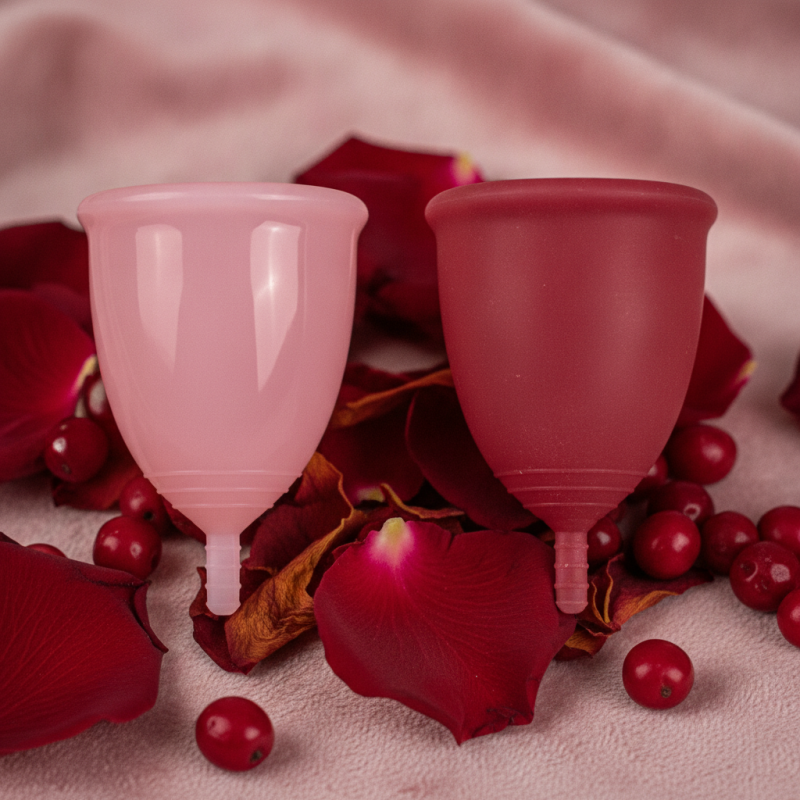
For heavy-flow nights: Sileu Classic — €14.99
Size L in our Classic model holds 30 ml up to the air holes, among the highest in the range, designed for the long stretch of hours you’re asleep and unable to empty it. Medical-grade silicone certified to ISO 10993. Shipped from Spain in 24-72h.
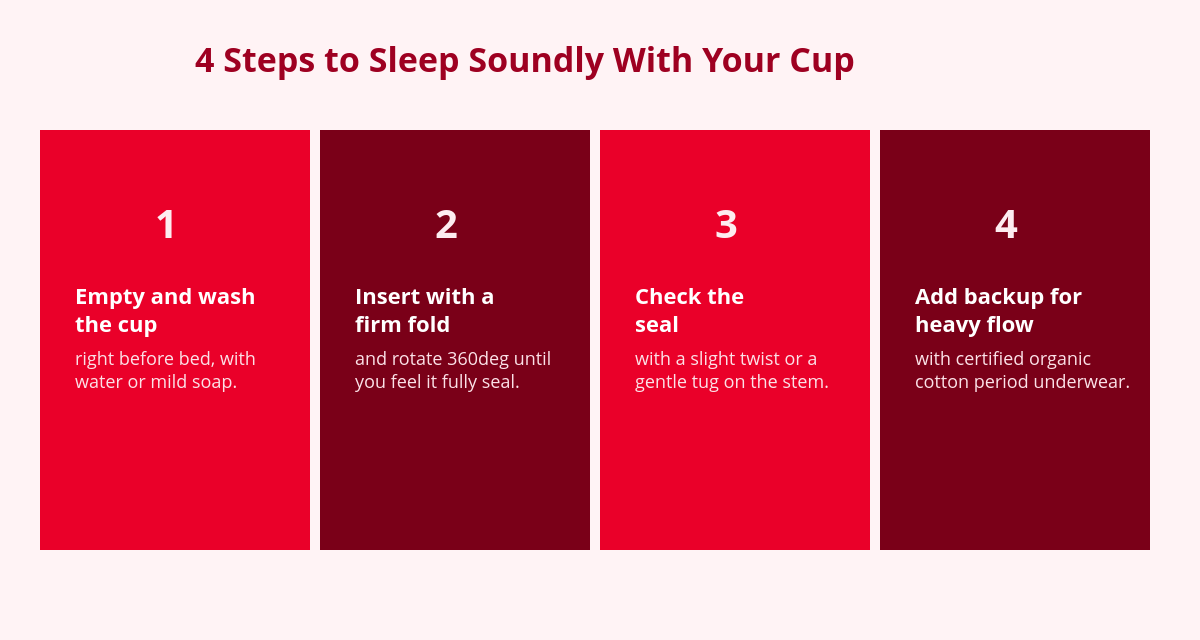
Not every cup is designed the same way for nighttime. If your priority is sleeping soundly, firmness and capacity matter more than size alone:
If you’re not sure what size fits you, our guide to finding your cervix and choosing your size answers that in five minutes, and if you’re torn between two sizes, the Starter Pack with size S and L (€21.99) lets you try both before deciding. And if this is your first time with a menstrual cup, start with our complete beginner’s guide.
Even though a well-placed cup shouldn’t leak, there are nights where peace of mind matters more than any statistic: the first time you try sleeping with a cup, on very heavy flow nights, or simply because you’re sleeping in a bed that isn’t your own. For those situations, there’s OEKO-TEX Standard 100 certified organic cotton period underwear (free from harmful substances): a second layer of security that absorbs any drop while the cup does the main work. Afterward, it washes and gets reused for years, just like the cup.
That’s exactly the combination in our Underwear + Sileu Rose Pack (€26.99): the cup for the night and certified organic cotton period underwear as backup, in a single pack designed to help you sleep without thinking about your period.
Cup + nighttime backup: Underwear + Sileu Rose Pack — €26.99
The Rose menstrual cup (German Wacker silicone) plus OEKO-TEX Standard 100 certified organic cotton period underwear, so you can sleep without worrying about stains. Shipped from Spain in 24-72h.
We ran the comparison with real numbers, because figures are more convincing than promises:
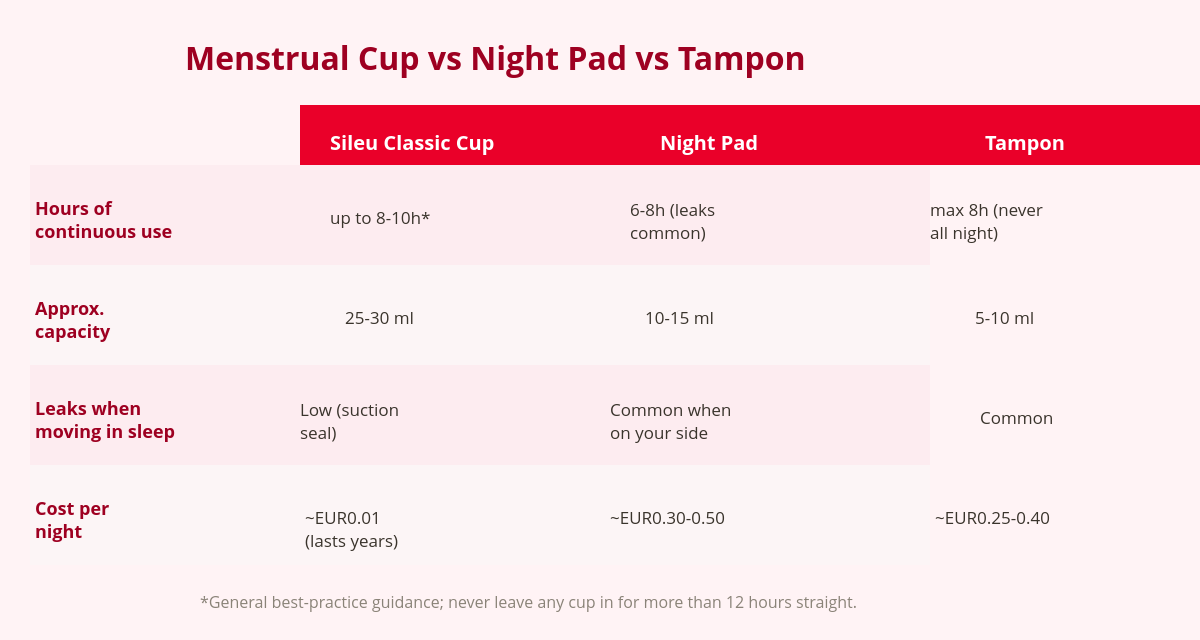
A night pad depends on you not changing positions, and a tampon should never be worn all night — manufacturers recommend a maximum of 8 hours. The cup, with its higher capacity and suction seal, is the only one of the three designed to hold up for a full night regardless of your sleeping position.
And here’s the angle almost nobody mentions: the disposables industry runs on you buying again every month. A €14.99-19.99 cup that lasts for years has nobody advertising it on TV. People who switch to a cup usually end up asking themselves, a few months later, why they didn’t do it sooner.
To minimize any nighttime risk, three habits are enough: wash your hands before inserting or removing the cup, clean it with water or a mild intimate soap every time you empty it, and sterilize it between cycles. If in the morning you notice sudden high fever, a skin rash, vomiting, or intense dizziness, remove the cup and seek emergency care: these are the described symptoms of toxic shock syndrome according to MedlinePlus, a rare but serious complication historically linked to prolonged use of internal menstrual products, not exclusive to cups.
If your nights are also disrupted by pain, bloating, or intense mood changes in the days leading up to your period, you might be noticing premenstrual syndrome symptoms, which are worth distinguishing from a simple bad night. And if what worries you isn’t sleep but the safety of the material itself, our roundup of scientific evidence on the menstrual cup gathers the available studies without dressing them up.
Sleeping with a menstrual cup is safe for most people if you choose the right size for your flow, stay within the 12-hour maximum, and keep up basic hygiene. If you’re just starting out, pair it with period underwear the first few nights: it’s the fastest way to build confidence and stop thinking about your period the moment you turn off the light. If you’re still torn between models, our comparison of all seven Sileu models helps you decide which one suits your nights best.
Yes. The systematic review in The Lancet Public Health (2019), covering 43 studies and over 3,300 participants, concludes that the menstrual cup is a safe option with leakage rates equal to or lower than pads and tampons, including during extended wear like overnight sleep.
A maximum of 12 hours straight, which a normal 7-9 hour night of sleep comfortably fits within. Empty it as soon as you wake up, especially on your heaviest flow days.
The Sileu Classic in size L, with 30 ml up to the air holes, is the most recommended for heavy-flow nights. If you have a low cervix, the Sileu Bell, our shortest cup, tends to be more comfortable.
Yes, it’s a very common combination for the first few nights or on very heavy flow days: certified organic cotton period underwear acts as a second layer of security while the cup does the main work.
Sudden high fever, a skin rash, vomiting, or intense dizziness are rare but serious warning signs: remove the cup and see a doctor. Aside from that, mild discomfort when inserting or removing it usually resolves by adjusting the size.
Keep reading:
“I washed them like any other underwear and within a few months they didn’t absorb the same”: it’s the number-one reason people are disappointed with
“I’ve had the same cup for three years, should I replace it now?” It’s a question we get often, and the honest answer is: it
We sell menstrual cups, so you’d expect this article to tell you the cup is perfect for everyone. It isn’t, and we’d rather tell you

