Guides for Use & Maintenance
How to Wash Period Panties So They Last for Years
“I washed them like any other underwear and within a few months they didn’t absorb the same”: it’s the number-one reason people are disappointed with


“I went to three pharmacies and none of them even knew what it was.” That’s the message we get every week from readers trying to figure out where to buy a menstrual disc — in Spain, today, it’s still a small odyssey. Here’s the honest answer upfront: your neighborhood pharmacy almost never has it, Mercadona simply doesn’t carry it, and online you’ll find everything — the good and the questionable. At Sileu we don’t sell menstrual discs (not yet), so we’re not here to push ours on you: we’re here to tell you what’s actually available in each channel, how much it costs, how to tell a decent disc from a bargain-bin one, and when a cup like the Sileu Tulip solves exactly the same problem for €14.99.
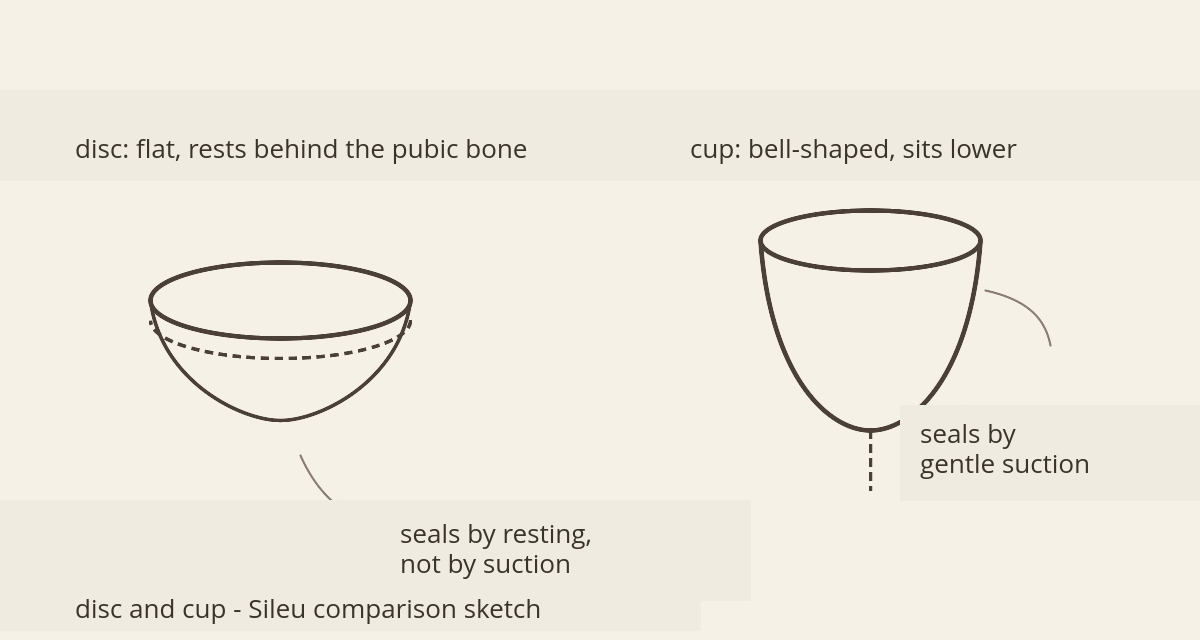
The menstrual disc is a flexible ring with a membrane that collects blood. Unlike the cup, it doesn’t seal by suction: it rests at the back of the vaginal canal, behind the pubic bone, sitting almost horizontally under the cervix. The cup, on the other hand, is a bell shape that sits lower and stays in place through gentle suction. Both are reusable (the silicone ones), both can be worn for up to 12 hours, and both collect instead of absorb. If the concept sounds familiar from our guide to choosing your first cup, it’s because the physics is the same: only the resting point changes.
Why is everyone suddenly talking about it? Because it promises two specific things: being able to have penetrative sex without removing it (the cup doesn’t allow that) and fitting well with a very low cervix. In exchange, it takes more practice to insert, it’s more awkward to empty, and “self-emptying” when you use the bathroom — its famous selling point — many users describe in practice as a hard-to-control downside.
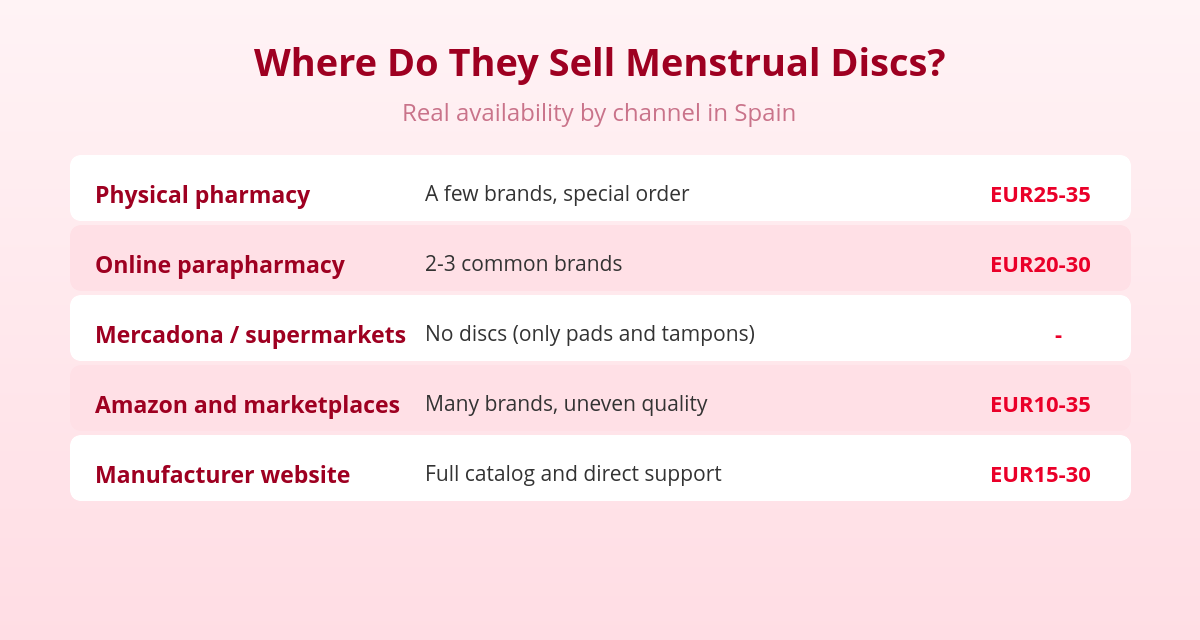
At physical pharmacies the disc is still a minority product: a large city chain might carry one or two brands, but usually they have to special-order it, at a price around €25-35. If a pharmacy carries cups, it’s often easier for them to get you a cup than a disc — the distributor is the same and the disc turns over slowly. The situation mirrors what we already covered with the menstrual cup at pharmacies: it exists, sure; whether it’s worth it depends.
At Mercadona, Carrefour, and other supermarkets, let’s be clear: there’s no menstrual disc for sale today. Mercadona sells pads, tampons, and little else in menstrual hygiene; we covered this in depth in our review of what Mercadona and Carrefour actually sell. If any chain adds it someday, it’ll likely be a single reference with no size options — the supermarket format doesn’t allow for advising on a product that requires matching your anatomy.
Online, you’ll find everything: serious European brands with certified silicone (€20-35), and unbranded discs for €6-10 on marketplaces, with no technical sheet, no material certification, and clumsily translated descriptions. With a product that’s going to spend 12 hours inside your body, the minimum filter is the same one we’d demand for a cup: medical-grade silicone with ISO 10993 certification, a size specified in millimeters, and a seller with real support you can actually contact. It’s the same criteria we apply in our general guide to where to buy a menstrual cup in Spain.
Low cervix, or torn between disc and cup? Sileu Bell — €14.99
Our shortest cup, with a body of just 30-35 mm designed for a low cervix: the comfortable fit that disc shoppers are after, with the simplicity of a cup. Medical-grade silicone, certified ISO 10993 (surgical-medical grade). Shipped from Spain in 24-72h.
The ranges you’ll see in Spain, no tricks:
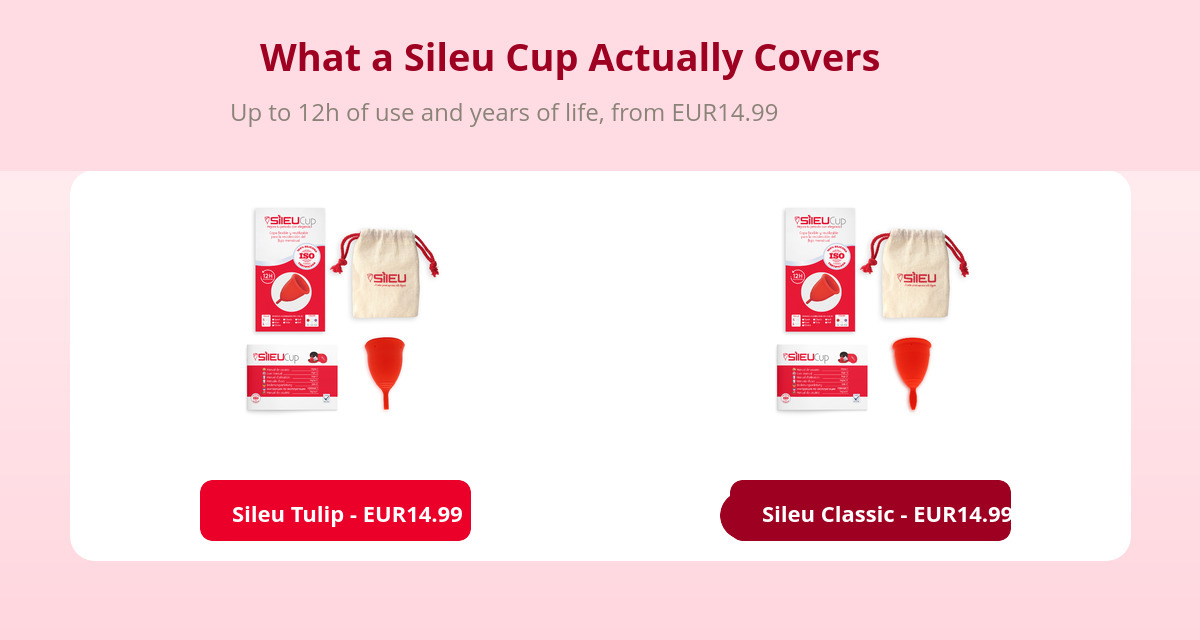
To put the price in context: a Sileu cup costs €14.99 (the Rose, €19.99), lasts for years, and ships from the factory with the same certified silicone you’d demand from a premium disc. We’ve already done the math against disposables in our advantages of the menstrual cup comparison: the reusable method pays for itself in 3-4 months. That, by the way, is exactly why neither discs nor cups get TV ads: the disposables industry runs on you coming back to the shelf every month, and a €15-30 product that lasts for years has nobody to advertise it.
Before chasing a disc across half the city, it’s worth separating real reasons from hype:
The systematic review published in The Lancet Public Health (van Eijk et al., 2019, 43 studies and over 3,300 participants) concluded that the menstrual cup is safe, with leakage rates equal to or lower than tampons and pads. The disc, much newer to the market, doesn’t yet have scientific backing of that caliber — another fact to weigh in.
If after all this the disc is still what you’re after, here’s the filter we’d use ourselves:
Mainly online: manufacturer websites and digital parapharmacies (€20-35). At physical pharmacies it’s uncommon and usually special-order. Supermarkets like Mercadona or Carrefour don’t currently sell menstrual discs.
No. Mercadona sells pads and tampons, but as of today doesn’t carry menstrual discs or menstrual cups in its intimate hygiene range. For a disc or cup, you need a pharmacy, a parapharmacy, or an online store.
It depends on your goal. The disc allows penetrative sex and fits well with a very low cervix, but takes more practice. The menstrual cup is easier to master, has solid scientific backing (The Lancet Public Health review with 43 studies), and covers every other scenario for €14.99-19.99.
Between €20 and €35 for brands with certified silicone, at a pharmacy or online. Marketplace discs under €10 usually can’t show ISO 10993 material certification, so they’re not recommended for prolonged internal use.
The no-experiments alternative: Sileu Classic — €14.99
Up to 12 hours of protection, years of lifespan, and direct factory price. If the disc never shows up at your pharmacy, the Classic is in your mailbox in 24-72h, shipped from Spain.
Keep reading:
“I washed them like any other underwear and within a few months they didn’t absorb the same”: it’s the number-one reason people are disappointed with
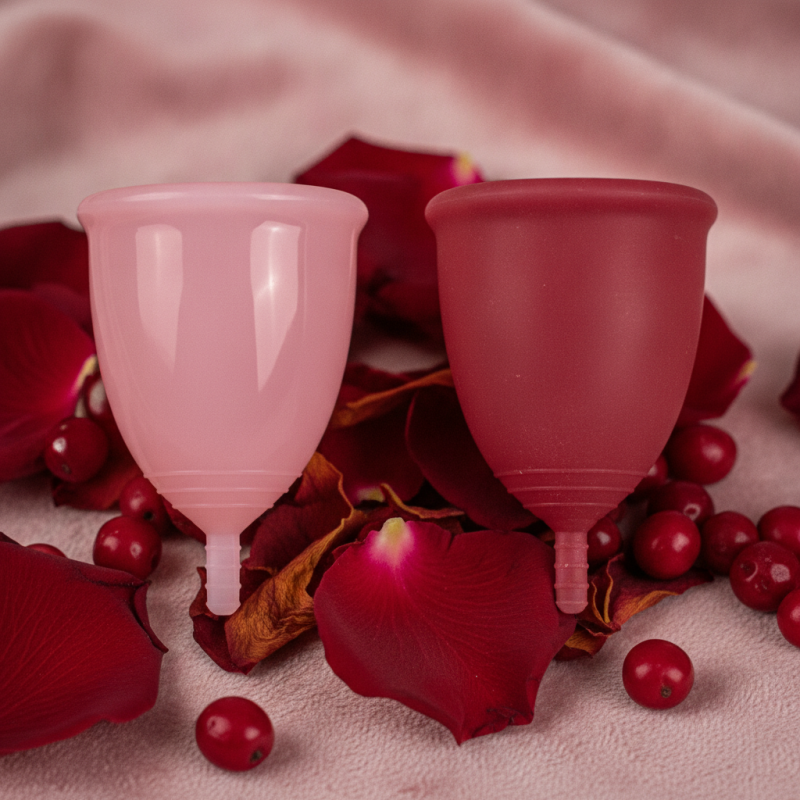
“I’ve had the same cup for three years, should I replace it now?” It’s a question we get often, and the honest answer is: it
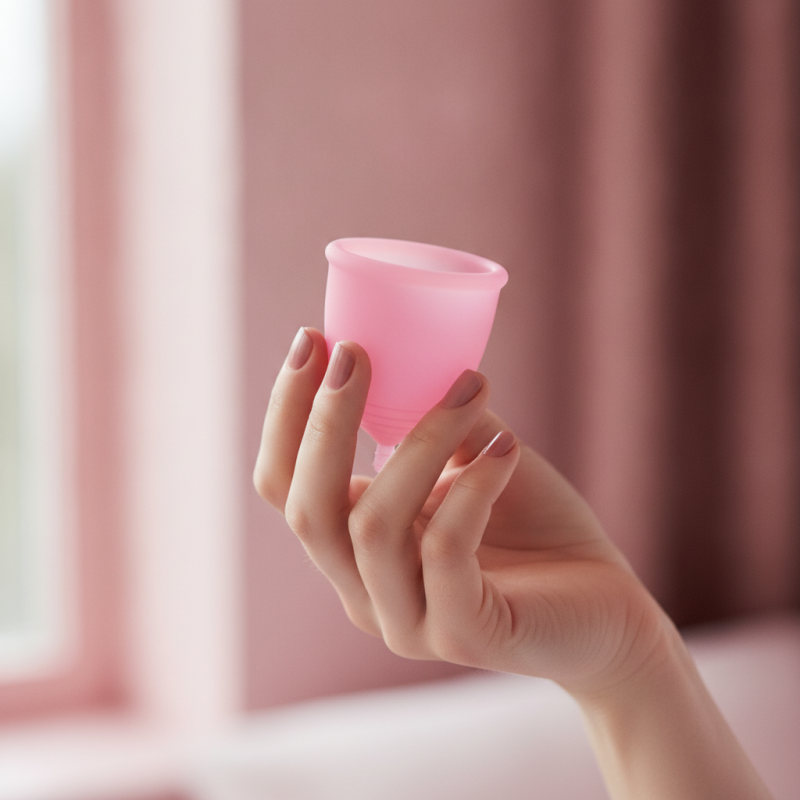
We sell menstrual cups, so you’d expect this article to tell you the cup is perfect for everyone. It isn’t, and we’d rather tell you

