Guides for Use & Maintenance
How to Wash Period Panties So They Last for Years
“I washed them like any other underwear and within a few months they didn’t absorb the same”: it’s the number-one reason people are disappointed with

“I’ve looked at the size calculator three times and I still don’t know if I’m an S or an L.” It’s the message we get most often at Sileu from women about to buy their first menstrual cup. The good news: if you’re right between two sizes, it’s almost never a serious mistake — and in this article we give you the real criteria (not just “your age”) to decide, plus a solution that saves you from having to get it right the first time.
Sileu cups, like most brands, are made in size S (small) and L (large). It isn’t a question of a “small or large body” as with clothes: menstrual cup size depends on your internal anatomy —vaginal length, cervix height, pelvic floor tone— and on your flow, not on your height or weight. That’s why two women with very different builds can need exactly the same size, and why the typical “by age” calculators are only an approximation.
When the standard recommendation (age and births) doesn’t settle it, look at these four factors in more detail:
None of these criteria decides it on its own: they combine. So if you still can’t see it clearly after reading them, you’re not the only one — it’s the most common situation among first-time cup users.
A fact that tends to reassure at this point: a systematic review published in The Lancet Public Health (van Eijk et al., 2019), which analyzed 43 studies with more than 3,300 participants, concluded that the menstrual cup is safe and that its leakage is equal to or lower than that of tampons and pads when the right size is used (source: PubMed). In other words, getting the size right mainly affects your comfort, not the safety of the product. You can try it without fear, knowing that the worst-case scenario with a poorly fitting size is an annoying leak, not a risk to your health.
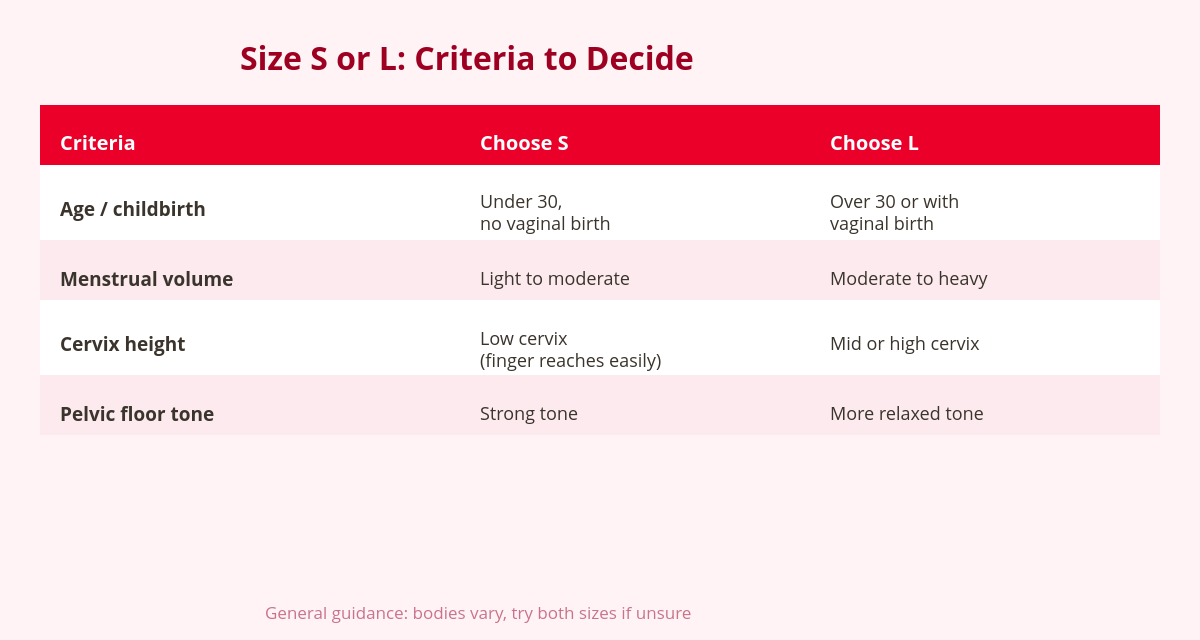
You don’t need to see a gynecologist for a first idea (although if you have medical concerns, always ask). With clean hands and in a comfortable position —sitting on the toilet or with one foot on the edge of the bathtub—, slowly insert a finger until you feel a firm, rounded surface, similar to the tip of your nose: that’s your cervix. If you can feel it at your first knuckle, your cervix is low (a short cup usually fits better). If you need to insert almost your whole finger, it’s mid or high (size L usually gives more margin). This check can vary with the day of your cycle, so if the result isn’t clear, that’s another sign that trying both sizes is the most reliable option.
Don’t confuse size with model: the size is the dimension (S or L), while the model determines the firmness and shape of the cup —firmer for a stronger seal, softer for more comfort—. You can have a low cervix and still need a firmer cup if your muscle tone is strong, or the other way round. So when in doubt, it’s worth checking which model suits your activity too: for example, women who exercise regularly tend to prefer the Sileu Sport (€14.99), with a firmness designed to stay in place during movement.
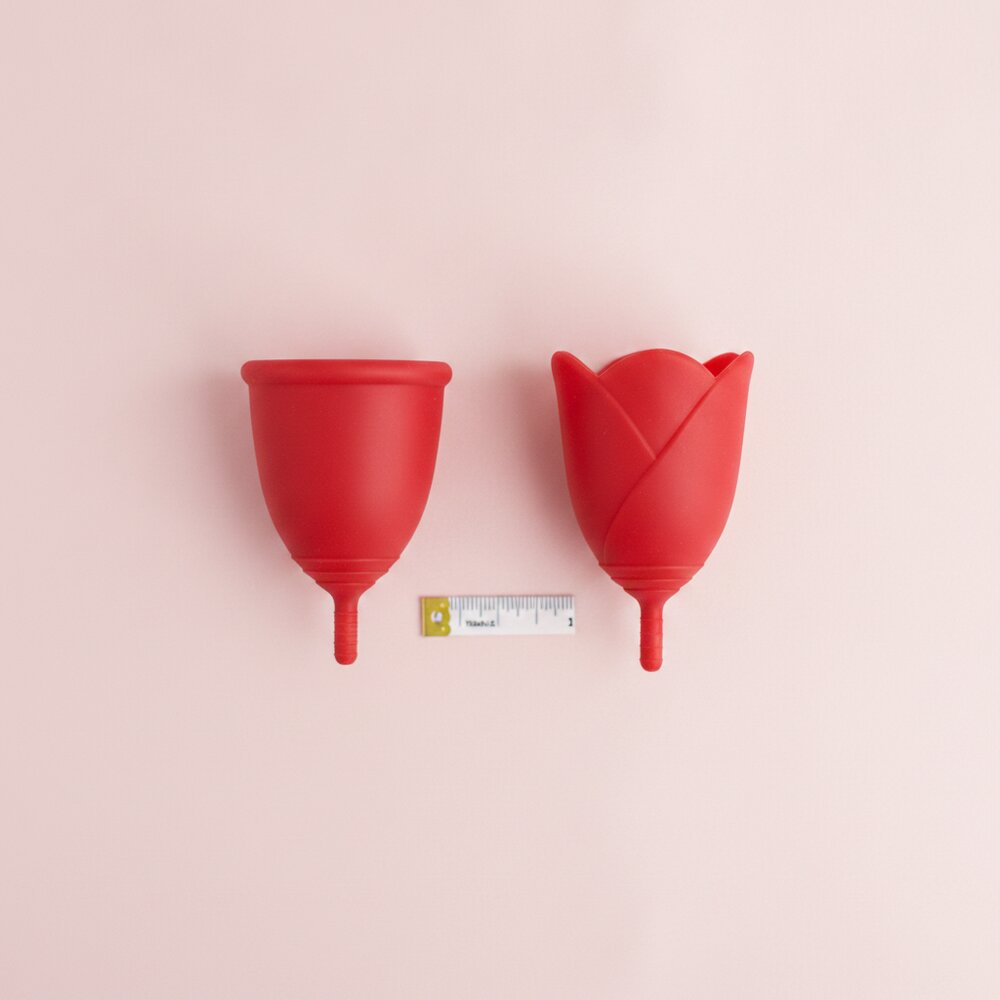
If you’re still torn between S and L after looking at the four criteria, the honest recommendation isn’t “guess”: it’s to try both. All Sileu cups —Classic, Sport, Soft, Tulip, Bell, Divine and Rose— come in both sizes at the same price, so the extra cost of trying both is minimal compared with getting it right from your first cycle. We go over the differences between models (which also matter, beyond size) in our guide to Sileu menstrual cup models.
It’s also common for the body to change: after a birth, with age, or simply because your period varies from one year to the next. It’s not unusual to go from S to L —or the other way round— over time, so keeping both sizes in your bag isn’t a whim, it’s the most practical way to avoid buying the wrong one again.
That’s what the Sileu Starter (€21.99) is for: it includes size S and size L of the model you choose, so you can try both during your first cycles and keep the one that really suits you, without guessing or paying twice. Made of medical-grade silicone certified to ISO 10993. Shipped from Spain in 24-72h.
Once you’re using it, your body will tell you. If the cup slips out on its own when you walk or strain, it’s usually too small for your muscle tone. If you feel pressure, discomfort when sitting, or it’s hard to get it to open after inserting it, it may be too big for your anatomy. And if you have leaks despite emptying it on time, check your insertion technique first —we explain it step by step in how to insert the menstrual cup step by step— and see how the menstrual cup should sit before assuming it’s a size problem.
If your period is especially heavy and you’re worried that even size L won’t hold enough, take a look at our guide on menstrual cups for heavy flow and their real capacity in ml, where we compare how much each model holds.
If it’s your first cup and you haven’t had penetrative sex or given birth, size S is usually the recommended starting point, although it isn’t an absolute rule. For those starting very young, we have a specific guide on menstrual cups for teens: size, model and first steps. If, on the other hand, you’ve just given birth, your body needs to heal before you go back to the cup —usually you wait until your postpartum check-up— and it’s almost always recommended to start directly with size L. And if you’re working out your size for the first time because you’ve just had your first period, our guide to the first period (menarche) gives more context.
There’s a fourth common case: women in perimenopause, whose cycle and flow can change noticeably from one month to the next. If your period has gone from moderate to very heavy (or the reverse) in recent months, it makes sense that the size that suited you a year ago may no longer be the most comfortable today. In these cases, going through the four criteria again —rather than assuming your size never changes— usually solves most of the discomfort.
People who switch to the menstrual cup after years of pads and tampons usually say the same thing: once you find your size, you wonder why it took you so long. And it makes sense — the disposables industry depends on you buying again every month, while a well-chosen €15-20 cup lasts for years with no need to repurchase.
One last practical tip: give your size at least two or three full cycles before deciding whether it’s the one. The first month with a new cup usually involves a learning curve —finding the insertion angle, learning to check the seal, gaining the confidence to empty it away from home— and it’s easy to confuse “I need more practice” with “it’s the wrong size”. If by the third cycle you still notice clear discomfort (constant pressure, repeated leaks despite good technique, or a feeling that it’s slipping), then it’s worth considering a change of size with more confidence.
Want to compare before deciding? In our complete guide to menstrual cup sizes you’ll find the guideline calculator by age and births, and on the Sileu Rose menstrual cup page (€19.99, sizes XS, S and L) you can choose your size directly when you buy. Shipped from Spain in 24-72h.
It depends on whether you’ve had vaginal births, on your flow, on your cervix height and on your pelvic floor tone, not just on your age. If you’re still between two sizes after weighing these factors, the most practical option is to try both with a pack that includes S and L.
It’s rarely a serious problem: you’ll notice leaks, pressure, or that it slips out when you move. You can switch sizes easily, and many women use different sizes at different stages of their life (before and after giving birth, for example).
No. Menstrual cup size depends on your internal anatomy (vaginal length, cervix height, muscle tone) and on your flow, not on your height or body weight.
Yes, it’s the most practical option when you’re genuinely unsure. The Sileu Starter includes size S and size L of the model you choose for €21.99, so you can try both and keep the one that best fits your body.
Yes, it’s common. After a vaginal birth the canal and the pelvic floor change, and switching to size L is usually recommended even if you used S before, always waiting until your postpartum check-up before using it again.
Keep reading:
“I washed them like any other underwear and within a few months they didn’t absorb the same”: it’s the number-one reason people are disappointed with
“I’ve had the same cup for three years, should I replace it now?” It’s a question we get often, and the honest answer is: it
We sell menstrual cups, so you’d expect this article to tell you the cup is perfect for everyone. It isn’t, and we’d rather tell you

