Guides for Use & Maintenance
How to Wash Period Panties So They Last for Years
“I washed them like any other underwear and within a few months they didn’t absorb the same”: it’s the number-one reason people are disappointed with


Did you know that more than twenty menstrual cup brands are sold in Spain today, and that the price difference between them can be more than double… using equivalent materials? If you’re trying to make sense of Enna, Intimina, Lunette, MeLuna, AllMatters or Sileu, this honest overview is for you: what each brand is, which channel it lives in, what makes it different — and the four objective criteria for evaluating any of them (including ours).
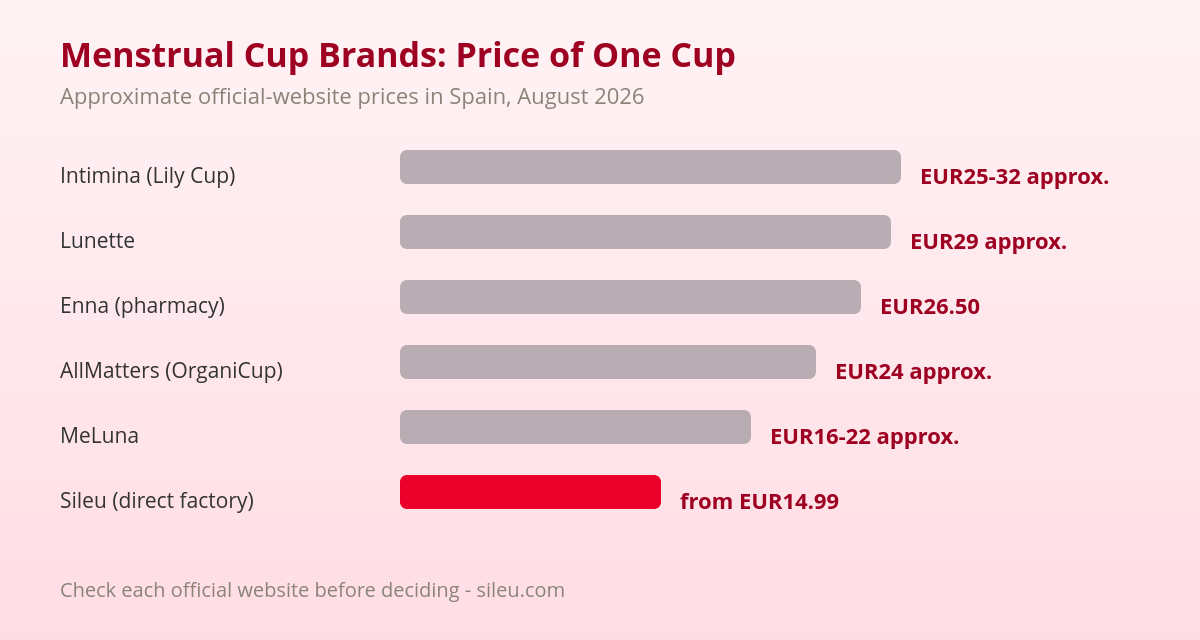
Enna is the Spanish brand of the pharmacy channel: two models (Original and Easy Cup, with an optional insertion guide) in three sizes, at €26.50 per cup. Its strength is the trust of the pharmacy counter; its drawback, the channel’s price. We compare it in depth in Enna vs Sileu.
Intimina is an international brand known for the Lily Cup, with a distinctive elongated design and a collapsible version designed to carry compactly. It sits in the upper price range (approx. €25-32 depending on the model). We compare it in Intimina (Lily Cup) vs Sileu.
AllMatters (formerly OrganiCup) is the minimalist Scandinavian: a single model in three sizes, with a sober image and a strong online presence. Around €24 on its website.
Lunette, Finnish and one of Europe’s veterans, offers two models of different firmness with a good reputation for durability, around €29.
MeLuna, German, is the champion of customization: it manufactures in TPE (thermoplastic elastomer, not silicone — we explain the difference in silicone vs TPE vs latex) with a huge number of combinations of size, firmness and stem, between approx. €16 and €22.
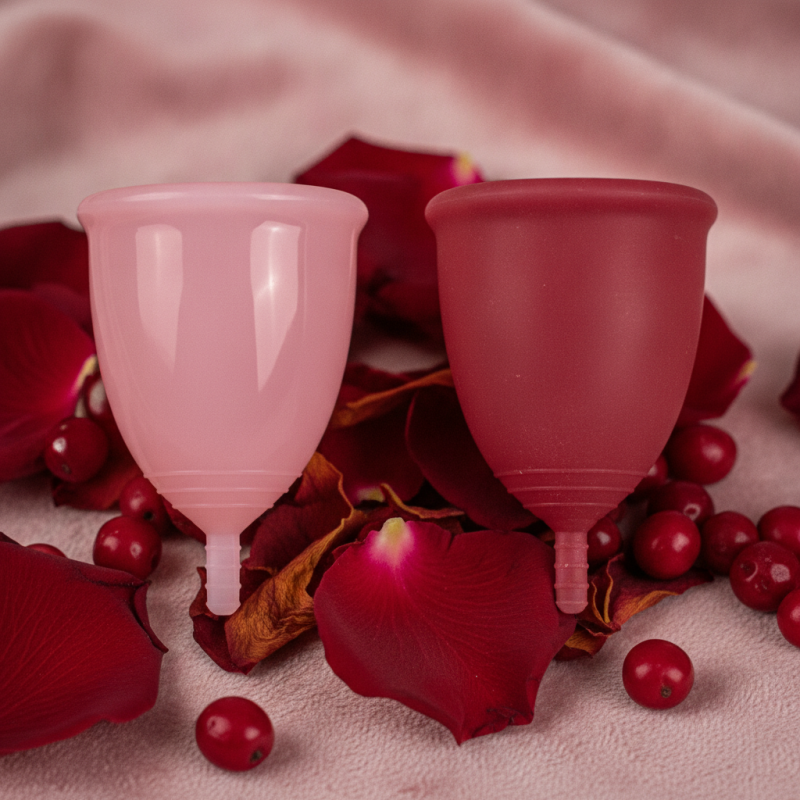
Sileu — us — is the Spanish direct-sale brand: seven models of different shapes and firmness (Classic, Soft, Sport, Rose, Tulip, Bell and Divine) from €14.99, made of medical-grade silicone certified to ISO 10993, with a 100% in-house design whose icon is the Rose, the rose-shaped cup designed in Spain in medical-grade silicone. By selling factory-direct, without intermediaries, the price comes down without touching the material.
Notice the pattern in the prices? It doesn’t depend on the quality of the material — all serious brands use certified silicone or TPE — but on the channel: the more intermediaries between the factory and your drawer (distributor, pharmacy, marketplace), the higher the price of the same type of product. That’s why the useful comparison between menstrual cup brands isn’t simply “which is best?”, but “what does each one give me for what it costs?”. And there’s another fact no campaign will tell you: since a cup is bought once and lasts for years, cup brands barely advertise — menstruation’s advertising business belongs to disposables, which make their money from your monthly repurchase. That’s why this market grows mainly through word of mouth from convinced users.
The prices quoted are those published on the official websites in August 2026 and some are approximate: always check them on each brand’s website before deciding.
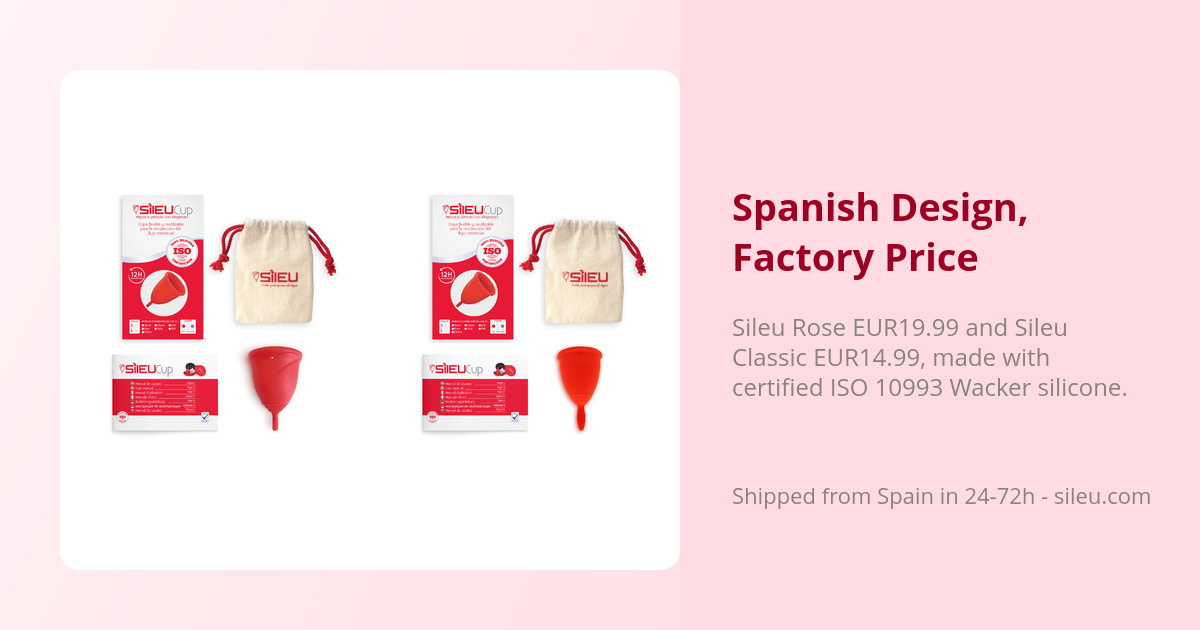
🌹 The cup that looks like no other: Sileu Rose — €19.99
Rose-shaped, designed in Spain, with a cotton pouch included. Designed so a first cup isn’t intimidating: the beginners’ favorite, with more than 500 units sold. And if you’re unsure about size, the Starter Pack S+L includes both for €21.99. Shipped from Spain in 24-72h.
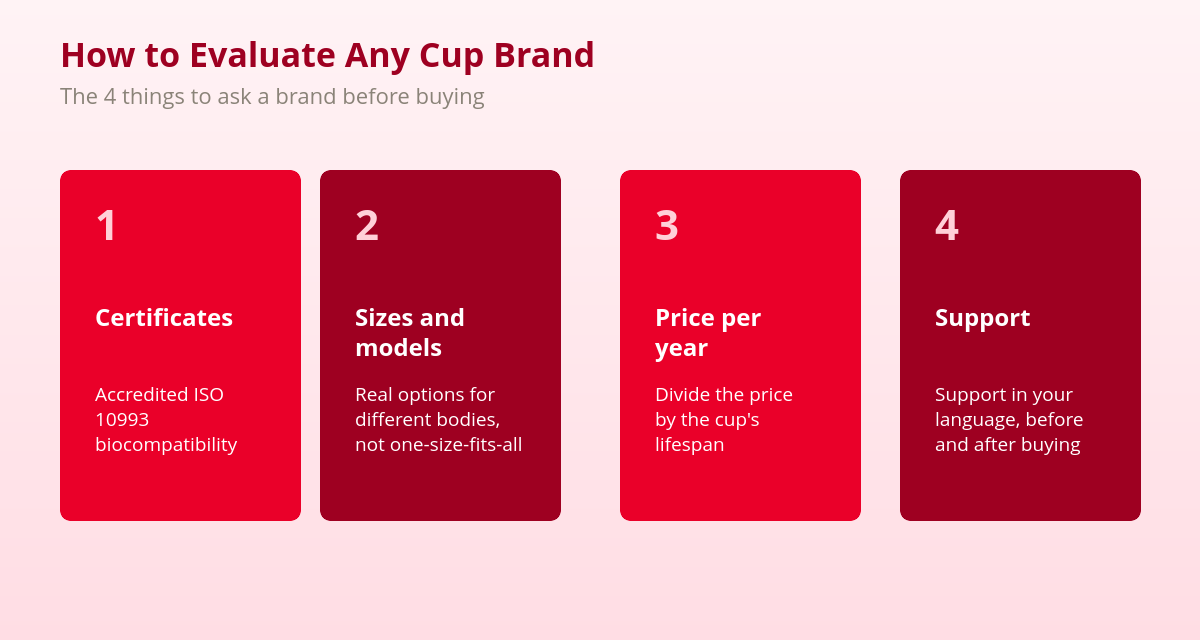
1. Verifiable certifications. The material should be medical-grade silicone (or TPE) with biocompatibility accredited under the ISO 10993 standard — the same family of standards as medical devices. “Medical grade” without paperwork to back it up is a slogan, not a certification: learn to tell them apart in our analysis of ISO 10993, USP and FDA. The serious brands on this list comply; with €6 cups from no recognizable brand, you often can’t tell.
2. Sizes and models for real bodies. High or low cervix, strong or weakened pelvic floor, light or heavy flow: there’s no universal cup. Look for a brand that offers real variety and helps you choose — starting with locating your cervix. Here MeLuna and Sileu are the most versatile; Enna and AllMatters the simplest.
3. Price per year of use. Any well-cared-for cup lasts years, so divide the price by its lifespan: the real difference between a €15 cup and a €30 one is a few euros a year… but it’s also true that the upfront outlay holds people back, and there €14.99 lowers the barrier to entry. Either way, every brand on this list is a bargain compared with the €60-90 a year, every year, on tampons and pads — the arithmetic the disposables industry would rather not publish.
4. Support and advice. The cup has a learning curve, and the difference between giving up on it and loving it is often having someone to ask. Look for support in your language, useful guides and after-sales response. It’s the most invisible criterion when you buy and the most decisive three months later.
The list above doesn’t cover the whole market: in supermarkets you’ll find own-brand cups for €9-15, and on Amazon dozens of brands that come and go, some decent and others with origins and materials that are hard to trace. You don’t need to know them all: apply the four criteria and they sort themselves. A verifiable ISO 10993 certification? Measurements in mm and ml on the product page? Someone behind it who answers? If a €6 cup fails all three questions, the saving isn’t worth it: we’re talking about a product that spends up to 12 hours inside your body. And if the channel matters to you as much as the brand — pharmacy vs supermarket vs Amazon vs factory website — we have a specific guide on where to buy a menstrual cup in Spain with the pros and cons of each.
An important point about brands and sizes: don’t try to translate your size from one brand to another by the letter. One brand’s S may measure like another’s M; what’s comparable is the diameter in millimeters and the capacity in milliliters. Before switching brands “because this one doesn’t seal for me”, check whether what’s failing is the brand… or the size: our guide to menstrual cup sizes answers that in five minutes, and saves you spending €25 repeating the same mistake with a different logo.
One last practical tip before the verdict: look at what happens after the purchase. Send a question to the support team of the brand you’re considering and time the answer; read how it handles the complaints visible in its reviews; check whether its size guides explain or just sell. That little ten-minute experiment predicts your experience as a user better than any comparison table — including ours.
All the brands in this article make safe cups — the safety of the cup as a product is backed by a review of 43 studies in The Lancet Public Health (2019) —, so the right question isn’t “which brand is the good one?”, but “which combination of model, size, price and support suits me?”.
Choose the pharmacy (Enna) if you need to buy it today or the counter gives you peace of mind. Choose an international brand (Intimina, Lunette, AllMatters) if a particular model convinces you and the price doesn’t hold you back. Choose MeLuna if you’re after a very specific combination of firmness and stem, knowing it’s TPE. And choose Sileu if you want certified silicone at the best price on the market (from €14.99), seven models among which yours will be, and support direct from the factory. If it’s your first cup, our beginner’s guide helps you choose model and size, and the FAQ answers the rest.
The most common are Enna (pharmacy channel, €26.50), Intimina (international, approx. €25-32), Lunette (Finnish, approx. €29), AllMatters/OrganiCup (approx. €24), MeLuna (German, in TPE, approx. €16-22) and Sileu (Spanish direct-sale brand, 7 models from €14.99).
Sileu, with cups from €14.99 made of medical-grade silicone certified to ISO 10993. The low price doesn’t come from the material but from the channel: factory-direct sales without intermediaries.
Insist on a verifiable biocompatibility certification (ISO 10993 standard) for the silicone or TPE, an identifiable brand with a technical sheet and clear measurements. The menstrual cup as a product is safe according to a review of 43 studies published in The Lancet Public Health (2019); the key is that the manufacturer certifies its material.
No. Each brand defines its own measurements: Enna uses S/M/L, others just two sizes, MeLuna has many combinations and Sileu uses S and L across seven different models (plus an XS in the Rose model). Always compare the diameter in mm and the capacity in ml, not the letter.
The all-rounder at factory price: Sileu Classic — €14.99
The most versatile model in the range, in sizes S and L, in medical-grade silicone certified to ISO 10993. And if you’re unsure about size, the Starter Pack S+L for €21.99. Shipped from Spain in 24-72h.
Keep reading:
“I washed them like any other underwear and within a few months they didn’t absorb the same”: it’s the number-one reason people are disappointed with
“I’ve had the same cup for three years, should I replace it now?” It’s a question we get often, and the honest answer is: it
We sell menstrual cups, so you’d expect this article to tell you the cup is perfect for everyone. It isn’t, and we’d rather tell you

